E-Bike Safety Programs for Schools & Councils NSW
Practical Bike Safety Education That Builds Real Skills
As e-bike use increases across NSW, schools and councils are facing a growing challenge:
How do we ensure young riders are not just informed — but actually safe?
Many programs focus on online learning or theory-based delivery.
At Pedal Set Go, we focus on something different:
Practical, face-to-face bike safety instruction that builds real-world skills, confidence and safer habits.
Trusted and Experienced
Pedal Set Go has experience working with and alongside organisations including:
City of Sydney
Transport for NSW (TfNSW)
City of Parramatta
NSW Health
Bicycle NSW
We regularly collaborate with local government cycling teams and road safety officers to support the development and delivery of practical bike safety programs.
Referees and further information can be provided on request.
Real Outcomes That Matter
Our programs are designed to deliver real outcomes, including:
improved rider confidence and control
safer decision-making in real environments
increased participation in riding and active travel
stronger support from families and communities
Why E-Bike Safety Education Matters
E-bikes are increasingly used for:
school travel
local trips
independent mobility for young people
While this brings many benefits, it also introduces risks when riders:
lack experience
overestimate confidence
have not developed key control skills
are unfamiliar with shared paths and road environments
Safety is not just about knowing the rules — it’s about applying them in real situations.
The Limitation of Theory-Only Programs
Online and classroom-based programs can:
introduce road rules
explain visibility and safety concepts
build general awareness
However, they cannot:
assess real riding ability
identify unsafe habits
adapt to different learning needs
confirm understanding through action
Completing a course does not guarantee safe riding behaviour.
Integrating Theory With Practical Instruction
Our programs include the key safety concepts commonly covered in online e-bike safety courses — combined with practical, face-to-face instruction.
This includes:
being seen and visibility
understanding the bike and basic safety checks
NSW road rules and shared environments
battery safety
what to do if something goes wrong
We also go further, covering the practical behaviours that support safer riding in real environments:
riding predictably so others can anticipate movements
communicating clearly through signalling, positioning and eye contact
riding graciously and respectfully around pedestrians and other road users
understanding positioning on roads and shared paths
choosing safer routes where practicable
recognising and responding to changing environments
applying road rules as simple, repeatable patterns using age-appropriate language
These concepts are not taught in isolation.
We:
explain them in context
check understanding through discussion
apply them during riding
reinforce them through practice
This ensures riders are not just exposed to information, but are able to understand, apply and retain it.
For schools and councils, this means a single, integrated program that combines:
theory + practical instruction + real-world application
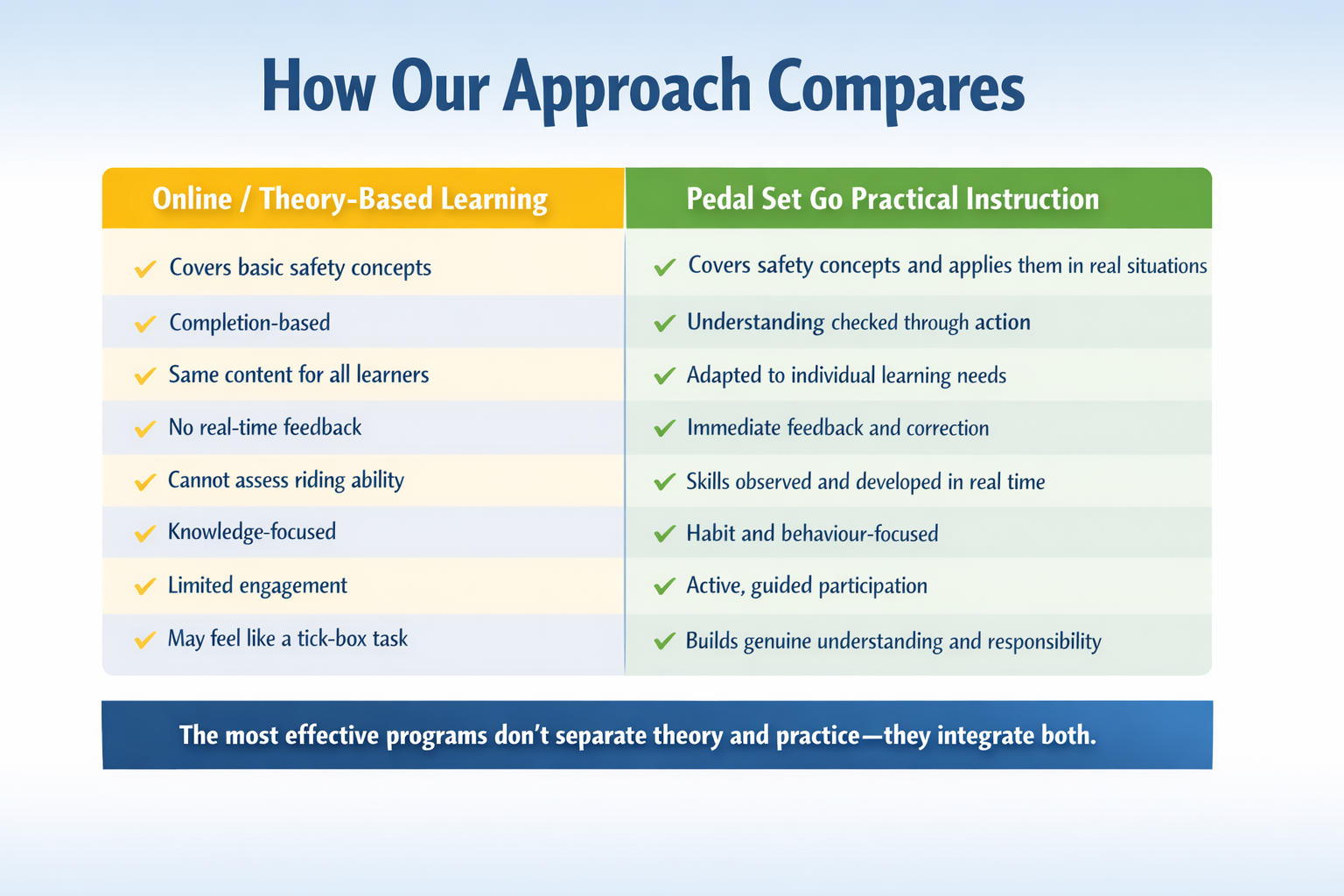
How Pedal Pet Go’s practical instruction compares to online theory-based e bike learning
What Makes Pedal Set Go Different
Pedal Set Go delivers real-world bike education, not just information.
Our programs are built around:
face-to-face instruction
guided, practical learning
real-time feedback
adapting to individual learning needs and styles
We work with riders to ensure they can:
control the bike confidently
make safe decisions
ride predictably around others
understand and apply their responsibilities
Face-to-Face Instruction: What It Allows Us to Do
In a live session, we can:
check understanding through action, not just answers
ask questions and adapt instruction in real time
respond to different learning styles and needs
ensure students are engaged, not just completing a task
reinforce the seriousness of riding safely
support understanding of rights and responsibilities
identify behaviours or habits that may increase risk
provide immediate, practical feedback
This creates genuine learning — not a tick-box outcome.
Building Foundations That Reduce Risk
Many bike-related incidents are not only about speed.
They often involve gaps in:
braking control
balance and coordination
awareness and scanning
positioning and predictability
decision-making under pressure
These foundational skills are often learned informally.
Our role is to identify and strengthen these skills early, reducing risk and improving long-term safety.
E-Bikes vs Regular Bikes: What Schools Should Know
We are often asked whether e-bike safety requires a completely different approach.
In practice, the core riding skills are the same.
Safe riding — on any bike — relies on:
balance and coordination
braking control
awareness and scanning
positioning and predictability
decision-making
These foundations apply to both conventional bikes and e-bikes.
Common Misunderstandings
“E-bike riders need completely different training”
The fundamentals are the same — however, they become even more important on heavier or more powerful bikes.
“E-bike sessions are faster”
Session pace is always based on:
rider skill level
confidence
environment
Not the maximum speed of the bike.
In most group settings, riding occurs at controlled, appropriate speeds, often well below maximum assisted speeds.
“E-bike riders progress faster”
Skill development takes time regardless of bike type. Riders still need to build coordination, control and safe habits.
Why Foundations Matter Even More on E-Bikes
E-bikes can be:
heavier
quicker to accelerate
more responsive under braking
This makes strong foundational skills even more important.
Our programs focus on:
control before speed
awareness before independence
confidence built on skill, not power
Inclusive Programs for Mixed Riders
We regularly deliver sessions with:
e-bike riders
conventional bike riders
mixed skill levels
Sessions are adapted so all riders can:
participate safely
progress at an appropriate pace
develop the same core skills
Program Options for Schools & Councils
We offer flexible delivery depending on your needs:
Small Group Instruction (Recommended)
Higher engagement
More individual feedback
Stronger skill development
Larger Group Formats
Structured sessions with practical components
Designed to maintain safety and engagement
Target Groups
Primary school students
Secondary students and teens
Mixed ability groups
Riders returning after loss of confidence
E-Bike Specific Safety Education
Our sessions can include:
handling heavier e-bikes
braking distance awareness
speed management
battery safety basics
safe riding in shared environments
Delivering Safe, Real-World Riding Environments
Our experience extends beyond teaching individual skills. We are also highly experienced in managing groups of riders in real-world environments.
This includes:
safely moving groups of riders in on-road and shared environments
adapting routes and delivery based on skill level and conditions
maintaining safe group flow, spacing and communication
Bike Safety, Maintenance and Roadworthiness
Our team also brings practical expertise in bike safety and maintenance, allowing us to:
identify whether a bike is safe and roadworthy
check for common issues that may increase risk
ensure bikes meet basic legal requirements
teach riders how to carry out simple safety checks themselves
Practical Expertise in Urban Riding
We specialise in bike riding for real-world transport in urban environments.
This includes:
applying road rules in dynamic situations
navigating shared paths and roads
making safe decisions in changing conditions
understanding risk while maintaining confidence and independence
Supporting Parents and Building Riding Communities
We also support parents and carers, recognising that family confidence plays a key role in whether children ride regularly.
When parents understand:
safe riding practices
how to support their child
how to identify and manage risks
children are more likely to:
ride to school
practise regularly
build confidence over time
We support this through:
parent guidance alongside sessions
answering questions and addressing concerns
reinforcing safe habits beyond the lesson
adult confident city rider individual and group courses
Cost-Effective Group Delivery
For schools and councils, practical instruction can be cost-effective per participant, particularly for groups of 10 or more.
Our focus is on outcomes — safer riders — not just course delivery.
Inclusive and Adaptable Delivery
Face-to-face instruction allows us to adapt in real time for riders who:
learn differently
need more time or repetition
benefit from structured approaches
Proven Experience and Approach
Pedal Set Go brings:
a strong track record
experience across all rider types
lived experience within our team
We are a practical, responsive and experienced bike education provider.
Partner With Us
Contact us to discuss a program: