Why Don’t Bike Riders Pay Rego? (And Why They’re Sometimes Still on the Road)
One of the most common frustrations we hear is this:
“Why don’t bike riders pay registration, and why are they on the road when there’s a cycleway?”
It’s a fair question, especially when roads feel busy and space is limited.
But the answer is more complex than it might seem. And when we look at the bigger picture, it becomes clear that cycling is not just about individual riders — it can reduce pressure on the transport network, support healthier communities, and help councils create places that work better for everybody.
Who actually pays for roads in Australia?
A common assumption is that roads are funded by car registration.
In reality, most road funding comes from general taxation, including income tax, GST, and federal and state government budgets. Registration contributes, but it does not cover the full cost of building and maintaining road networks.
That means everyone contributes to roads in some way — whether they drive, ride, walk or use public transport.
Do cyclists damage roads?
This is where the difference becomes clearer.
Road wear increases dramatically with vehicle weight. Heavy vehicles cause the vast majority of road damage, while bikes create negligible wear in comparison.
In practical terms, the cost impact of bikes on road infrastructure is close to zero. If registration were based purely on road damage, bikes would contribute very little.
The bigger picture: cycling benefits the whole system
Transport is not just about infrastructure. It is about how efficiently a whole system works.
When more people ride bikes, even some of the time, it can help:
reduce congestion
lower demand for road and parking space
reduce emissions
support physical and mental health
improve access for short local trips
make more efficient use of public infrastructure
Driving, by contrast, requires significantly more space and infrastructure and carries higher long-term congestion, health and environmental costs.
That is why many transport strategies increasingly support more people riding — not as an alternative for everybody, but as part of a more balanced and efficient network.
You can also see this in local centres. People arriving by bike or on foot often make frequent local visits, and bike parking can allow more people to access shops and services using the same amount of street space. For councils, that makes active transport not just a mobility issue, but also a liveability and place-making issue.
Why don’t cyclists pay registration?
It mostly comes down to practicality.
Introducing bike registration would likely:
cost more to run than it generates
be difficult to enforce
add administrative complexity
deliver little meaningful infrastructure benefit
In short, it is unlikely to improve how the transport system works.
How shared systems actually work
Most public systems are not based on direct one-to-one use.
We do not only pay for:
the exact roads we drive on
the hospitals we personally use
the schools we attend
Instead, we contribute to systems that support society as a whole.
Transport works the same way.
Some people drive more.
Some people ride.
Some people walk or use public transport.
A balanced system reduces pressure on infrastructure, improves efficiency, and benefits the broader community.
Why are cyclists sometimes on the road instead of the cycleway?
This is the second major frustration people raise — and again, there are practical reasons.
Cycleways and bike lanes are not always the same thing
Part of the confusion is that people often use the terms interchangeably.
A bike lane is usually a marked lane on the road reserved for bicycles. A cycleway is a broader term often used to describe cycling infrastructure more generally, including off-road bike paths, separated routes and, in some cases, bike lanes.
That means a rider might move between different types of cycling infrastructure during one trip, depending on where the route goes and what conditions are like.
Cycleways do not always go where people need to go
Not all routes connect directly to destinations.
Riders may be:
turning soon
linking between routes
travelling to a place the path does not reach
Conditions on cycleways vary
Riders may avoid paths because of:
debris such as glass, leaves or sand
congestion with pedestrians
poor visibility
uneven surfaces or maintenance issues
At times, the road can be the safer or more predictable option.
Not all bike lanes are equal
There is a big difference between painted lanes and protected, separated infrastructure.
Painted lanes — especially in the door zone next to parked cars — are not considered best practice in modern design guidance.
Safer infrastructure separates riders from traffic, but it is still limited in many areas.
Riders are not always required to use them
Rules can vary by state and territory, but in many cases a bicycle lane only applies where it is clearly marked. That is usually shown by a sign or a road marking with a bicycle symbol and the word “Lane”.
Even then, riders may still need to leave the lane if it is blocked, full of debris, poorly maintained, or otherwise unsafe to use.
That is one reason riders are sometimes on the road, even when bike infrastructure appears to be available.
Why riders sometimes take the lane
Another behaviour that can be confusing is when a rider moves further out into the lane.
In many cases, this is about safety.
Riders may position themselves more visibly to:
avoid the door zone next to parked cars
reduce the risk of being squeezed by passing vehicles
make their movements more predictable
When riders are clearly positioned, drivers will often give more space when overtaking, not less.
A note on overtaking
In Australia, drivers are generally allowed to cross centre lines, including double lines, to overtake a cyclist when it is safe to do so.
Many people are understandably cautious or unsure about this.
In practice, this can mean drivers wait behind a rider even when it is safe to pass — something we regularly see when working with both riders and drivers in real-world settings.
Sometimes, it is just as fast
It might not feel like it from inside a car, but over short distances:
bikes often travel at similar average speeds to cars in urban areas
many car trips fall within typical cycling distance
When you factor in congestion, traffic lights and parking, the difference is often smaller than people expect.
Why this matters to councils
For councils, this is not just a transport question.
It connects to broader goals around:
community health
emissions reduction
liveability and connection
local business activity
safer shared spaces
more efficient use of limited public space
As councils increasingly think in more connected, place-based ways, active transport can help support multiple outcomes at once. It is not simply about moving bikes. It is about helping communities move better overall.
That is why rider education, behaviour change and community confidence matter. Infrastructure plays a major role, but the experience of shared paths, roads and public space is also shaped by how people use them.
What actually improves the experience for everybody?
At Pedal Set Go, we see this play out every day through the education and community engagement programs we deliver with local and state government partners.
The goal is not to divide people into drivers and cyclists.
It is to support people to move through shared spaces more confidently and considerately — whether they are driving, riding or walking.
That includes practical behaviours like:
making space for others when it is safe
using a bell or friendly voice when approaching
riding predictably
being aware of different speeds and needs
understanding how to share paths and roads more confidently
These small actions often have more impact on safety and comfort than debates about registration.
For councils and organisations, practical rider education and community engagement can help:
improve shared path behaviour
reduce community friction
support safer, more confident riders
encourage more people to choose active transport for short trips
Final thought
The question is not really:
“Why don’t cyclists pay rego?”
It is:
“How do we create a transport system that works better for everybody?”
And increasingly, the answer includes making space for more ways to move — not fewer.
Work with Pedal Set Go
If your council is looking to improve rider confidence, support safer shared path behaviour, and encourage more people to move actively and confidently through their community, Pedal Set Go can help.
We partner with councils and organisations to deliver practical cycling education and community engagement programs that support community connections and safer, more confident riding.
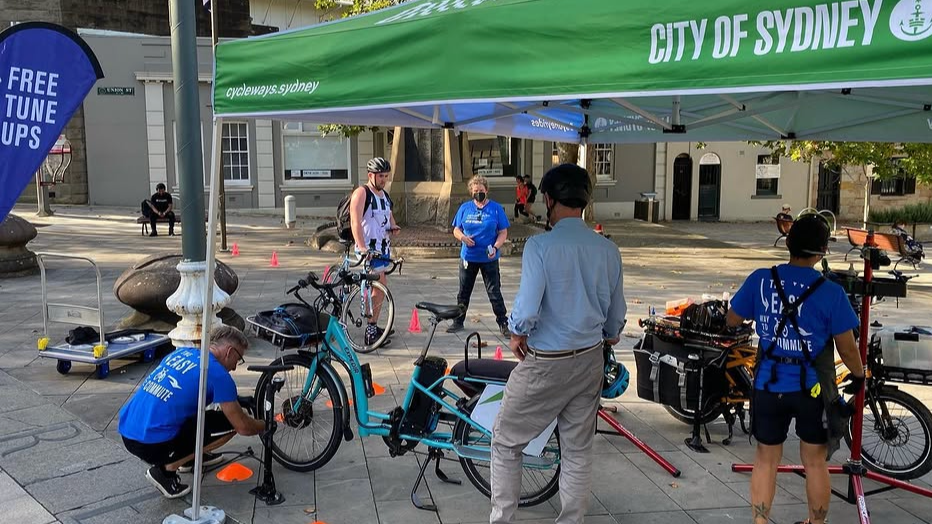
Pedal Set Go educators at Union Square providing bike advice and tune-ups through the City of Sydney Share the Path program.