How to Be More Visible on a Bike: It’s More Than Hi-Vis
How do you make yourself more visible when riding a bike?
The obvious answers are bright clothing, reflective gear and good bike lights.
They can all help.
But at Pedal Set Go, we think about visibility more broadly.
We often talk about high-visibility behaviour.
That includes clothing and equipment when appropriate, but it also means positioning yourself where you can be seen, observing what's happening around you, communicating clearly and moving predictably.
Being seen isn't only about making yourself brighter. It can also be about where you ride, how you move, whether another person recognises you as a person riding a bike, and whether your actions help them understand what you're going to do next.
We think of it as three related questions:
Can somebody notice me?
Can they recognise what I am?
Can they understand what I'm doing?
Clothing and equipment are part of the answer. So are movement, road position, observation, communication and predictability.
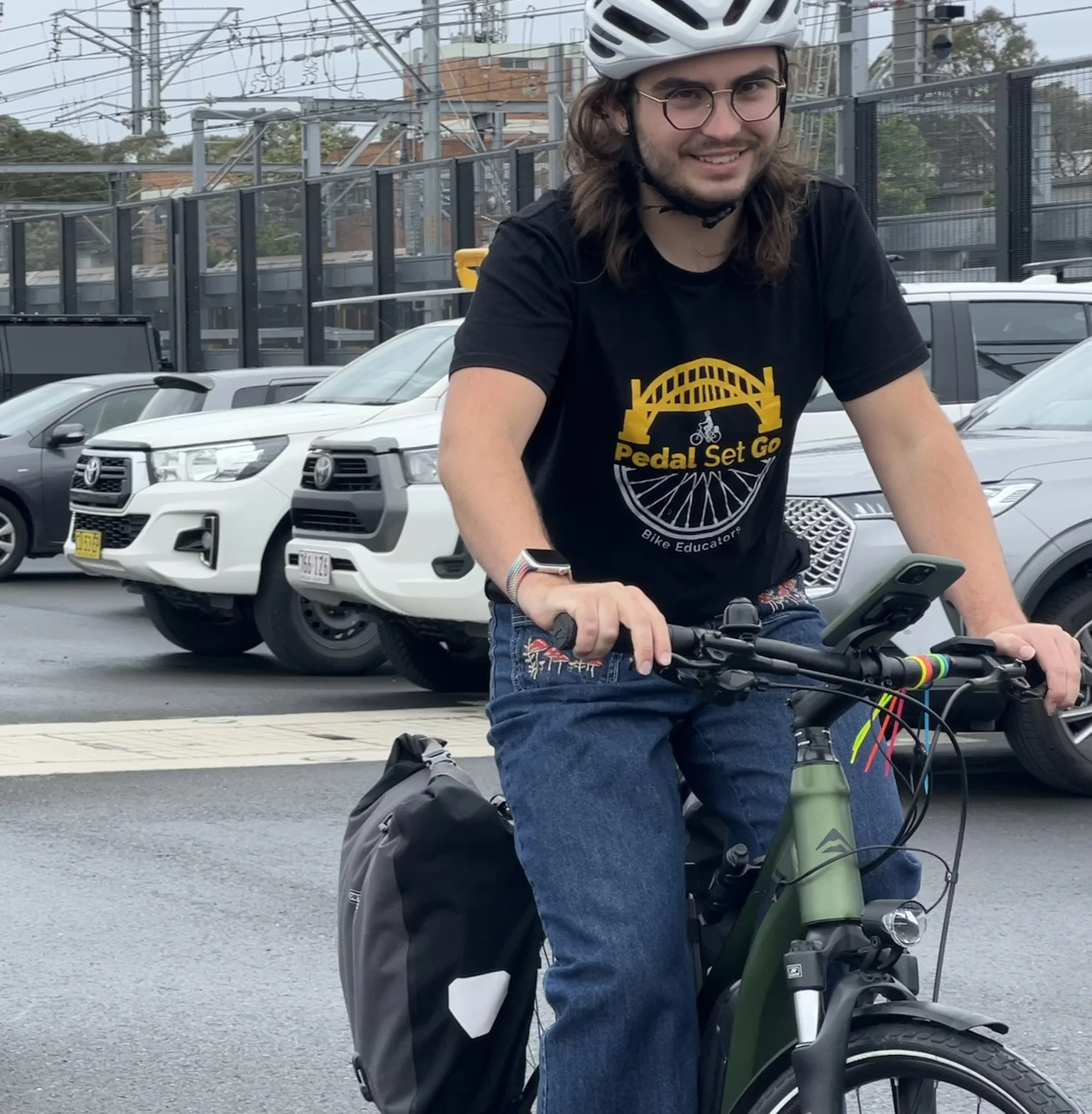
Our instructor positions himself away from parked cars and further into the traffic lane, giving himself space if a vehicle pulls out or a door opens, while positioning where people driving are more likely to see him.
Being visible is not the same as being safe
Let's start with something important.
Advice about cycling visibility can very easily drift into victim blaming.
If a person driving fails to see somebody riding a bike, the question shouldn't automatically become: What was the rider wearing?
People driving have a responsibility to look, see, give appropriate space and respond safely. Safer streets, appropriate speeds and well-designed infrastructure matter enormously too.
Nothing in this article transfers that responsibility to the person riding a bike.
What we can do as riders is use the tools available to us to give other people good opportunities to notice us, recognise us and understand what we're doing.
And there's more to that than a fluorescent vest.
Hi-vis, fluorescent and reflective aren't the same thing
These terms are often used interchangeably, but they do different jobs.
Fluorescent materials are particularly useful during daylight because they use ultraviolet light to appear especially bright.
Retroreflective materials work differently. They return light towards its source, which is why they can become dramatically more noticeable when illuminated by vehicle headlights at night.
NSW Government guidance recommends bright clothing during the day and reflective clothing at night.
But research suggests where reflective material is placed can matter too.
Does hi-vis always stand out?
Not necessarily.
Visibility depends on contrast.
The UK Transport Research Laboratory describes conspicuity as the relationship between an object and its background. A fluorescent yellow jacket may stand out dramatically in one environment and be much less noticeable in another.
That matters in busy streets, where our visual field can already contain signs, vehicles, advertising, lights, workwear and many competing colours.
So rather than assuming that putting on something fluorescent automatically makes us highly visible, it can be more useful to think about the whole situation:
What is behind me?
What are the light conditions?
Am I visually separated from the background?
Are my lights working effectively?
Does my movement help somebody recognise that I'm a person riding a bicycle?
And am I positioned somewhere other people have a good opportunity to see me?
Hi-vis can be useful. But visibility isn't created by a colour alone.
Your moving legs can help somebody recognise you
This is one of our favourite pieces of cycling visibility research because it is about how humans see other humans.
Researchers have investigated something called biological motion, or biomotion.
Our visual system is remarkably good at recognising the characteristic movement of another person.
When reflective material is placed on moving joints such as ankles and knees, the movement can help an approaching driver recognise that what they're seeing is a person.
Australian research from Queensland University of Technology has found that reflective markings on cyclists' moving joints can substantially improve recognition at night.
Other research has found benefits during daylight too. In one experiment, combining a fluorescent jersey with fluorescent leg coverings allowed people to recognise a cyclist at more than three times the distance of the same fluorescent jersey without the leg coverings.
This is why we shouldn't think only about making the largest possible part of our torso bright.
Movement can carry information too.
It's also one reason we love the additional Redshift Arclight Pedals we use on our bikes. As the pedals move, the lights move with the unmistakable rhythm of somebody riding a bicycle.
They don't replace the lights required on the bike. They're another layer of conspicuity, and they look pretty fabulous too.
We also use pedalling itself as a form of communication.
When we're riding through an intersection or past a side street, we'll often continue to turn the pedals even while slowing down or gently applying the brakes. That movement can help make us recognisable as a person riding a bike, while also communicating that we're continuing through.
It's another example of something we teach regularly: our movement and body language can give other road users useful information about what we're doing.
Of course, having priority doesn't guarantee that another person has seen you or will give way. We still observe, adjust our speed and prepare to respond.
Bike lights matter during the day as well as at night
Good lights are another part of our visibility toolkit.
In NSW, when riding at night or in hazardous weather conditions with reduced visibility, a bicycle must display a white light at the front and a red light at the rear, each visible from at least 200 metres, as well as a red rear reflector visible from at least 50 metres when illuminated by headlights.
Lights don't have to be reserved for darkness.
Research has found that bicycle lights can increase cyclist conspicuity during daylight as well.
At Pedal Set Go, using lights is a normal part of how we ride.
But brighter isn't automatically better.
A badly aimed, extremely powerful front light can dazzle somebody coming towards you, particularly on a shared path. Your aim is to help other people see you, not make it harder for them to see anything else.
Road position is part of visibility
You can be wearing something extraordinarily bright and still put yourself somewhere another road user isn't looking.
That's why we teach positioning as a visibility skill.
Sometimes moving further into a lane can make you more visible than riding as far left as possible.
Think about approaching an intersection beside parked vehicles.
Being tucked close to the kerb may feel as though you're staying out of the way, but it can also put you amongst visual clutter or behind vehicles that obstruct sight lines.
Good positioning is not about claiming space for the sake of it.
It's about seeing and being seen, giving yourself space to respond and helping other people understand where you're going.
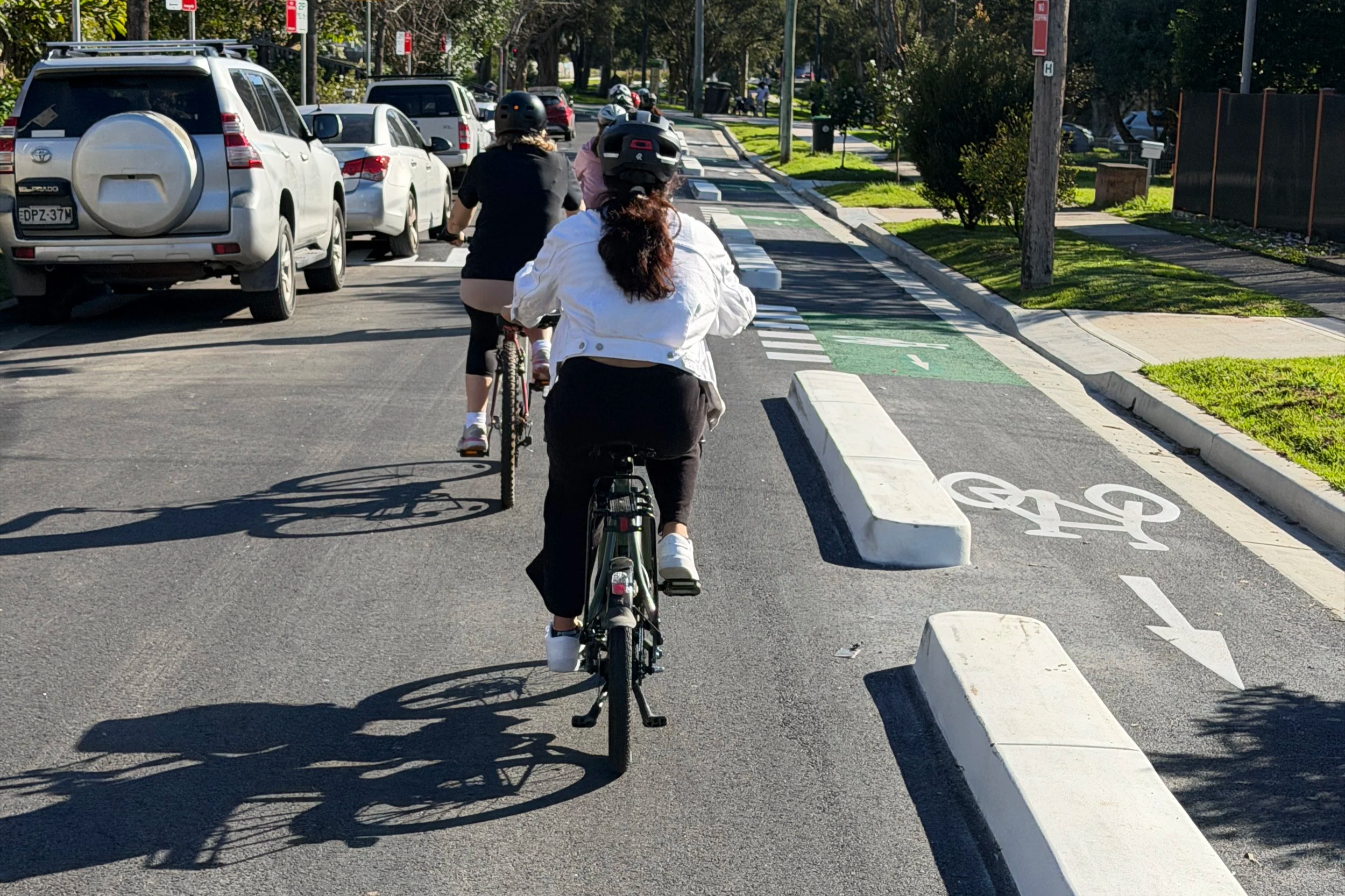
A group of riders in Parramatta position themselves outside the door zone of parked cars while riding single file on a quiet street. The separated cycleway beside them runs in the opposite direction. Their position provides space from opening car doors while helping them remain visible and predictable to other road users.
Looking is something we do for ourselves. Sometimes we move our head so other people can see that we've looked.
This is something we practise a lot in bike education.
Observation is obviously about gathering information.
What's behind me?
Is somebody approaching?
Is there a gap?
Has anything changed?
Some people use mirrors. We're often asked whether we recommend them.
Our answer is that a mirror is a personal choice. It can be a very useful tool for gathering information and may be particularly useful for somebody whose mobility makes a large head turn difficult.
But there's another part of observation that is easily overlooked:
Our body movement communicates too.
Sometimes we'll deliberately turn or tilt our head towards another road user, even when we've already seen them if using a mirror.
We're not necessarily trying to stare directly into their eyes.
We're making our observation visible.
A change in the direction of your face or a deliberate head movement can communicate something quite human:
I know you're there.
Research into cyclist-driver interactions increasingly recognises that encounters on the road aren't purely mechanical exchanges between vehicles. People use combinations of body movement, head movement, road position and explicit signals to interpret what other people are doing.
A head movement isn't a substitute for a clear signal. It doesn't necessarily tell another person where you're going.
But riding a bike is a social activity, and body language can be part of that communication.
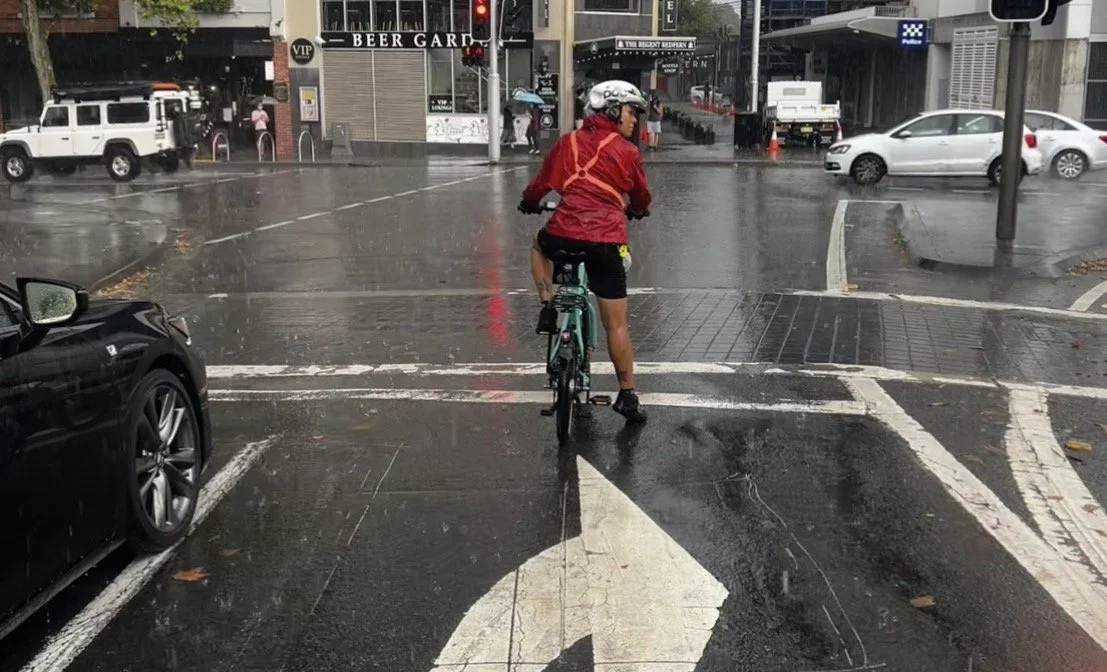
A rider looks back towards traffic while stopped in primary position at traffic lights in Redfern. Despite traffic in the neighbouring lane, the driver behind has left a generous space. Her head turn makes her awareness visible and creates a human interaction, while her red clothing and reflective sash add conspicuity in the wet conditions.
Signal what you're going to do
Being noticed is useful.
Being understood is even better.
Clear signalling gives other people information about your intentions.
So does your speed.
So does your position.
So does the timing of a movement.
Moving predictably gives other people more time to understand what is happening and respond.
That's one reason we teach Control, Observation, Communication and Positioning as connected skills rather than treating visibility as something you put on before leaving home.
You can be extraordinarily visible and still surprise somebody.
Our goal is to be visible and understandable.
What about hi-vis clothing?
We aren't anti-hi-vis.
We just don't treat a fluorescent vest as the foundation of safe riding.
During much of our daytime teaching, you'll see the Pedal Set Go team in our regular black work shirts.
We don't choose black because black is inherently safer. It isn't.
Our daytime workwear reflects the fact that we don't treat clothing as our primary visibility strategy. We put much more emphasis on road position, observation, communication, appropriate lights and recognising when conditions call for additional conspicuity.
We also want bike riding to look like an ordinary thing that ordinary people do, rather than something requiring specialist sports clothing or dressing like a road worker.
There's an interesting human dimension to this too.
Australian research published in 2023 examined how safety attire affected perceptions of people riding bicycles. In a study of 563 people, images of cyclists wearing helmets or safety vests were more likely to be selected as appearing less human than images without the safety equipment.
That does not mean taking off safety equipment makes somebody safer, and bicycle helmets are required by law in NSW.
But it raises an interesting question about how we present people riding bikes.
A person on a bike is still a person.
Sometimes being recognisably human matters too.
And sometimes we absolutely wear the vest
Conditions change.
At night, in poor light and in wet weather, you'll often see us adding reflective or high-visibility clothing.
And ours tends to get noticed.
We're fans of Hey Reflect'o, a small Australian business created by Lisa Penney.
Lisa started Hey Reflect'o because she wanted to be easily seen while riding without having to put conventional workwear over whatever she was already wearing.
The resulting vests are difficult to ignore.
They're colourful, distinctive and use fluorescent materials for daytime conspicuity and reflective designs that come alive under headlights.
Ours regularly attract comments when we wear them.
Our Hey Reflect'o vests feature the Aboriginal flag and the words Always Was, Always Will Be. We love that something designed to make us more visible can also communicate something about our values.
And that is rather the point.
We like supporting a small Australian maker, and we particularly like the idea that visibility equipment doesn't have to remove personality.
It can actually add some.
This isn't a sponsored recommendation. We just genuinely like what they make and wear it ourselves.
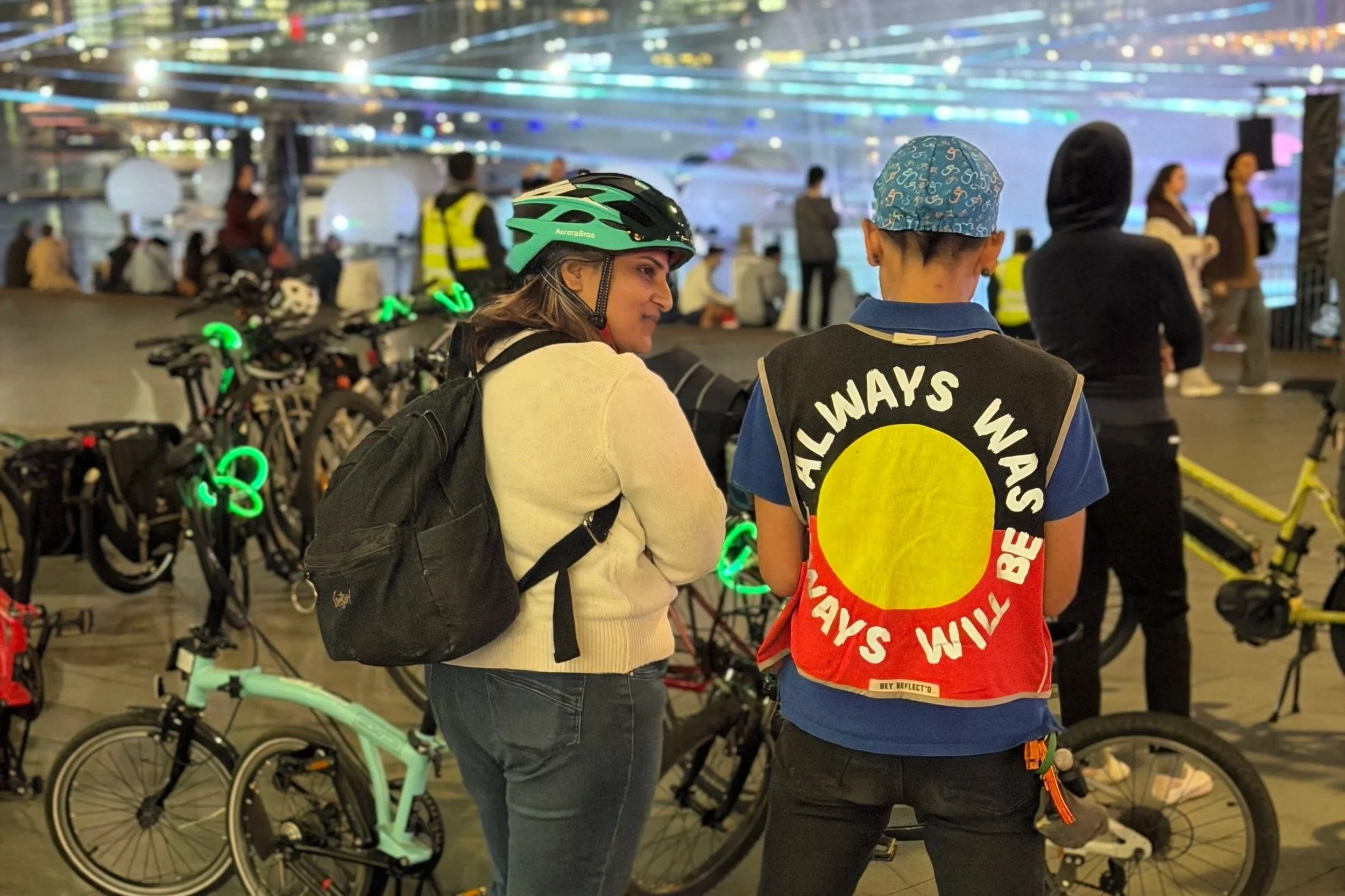
Riders pause to enjoy the lights of Vivid Sydney during a Pedal Set Go guided night ride. Colourful lights help make the bikes and their movement conspicuous after dark, while our instructor wears a fluorescent and reflective Hey Reflect'o vest featuring the Aboriginal flag and the words Always Was, Always Will Be. The scene shows how night-time visibility can combine lights, reflective materials, movement and personality.
So, how can you be more visible on a bike?
Rather than looking for one magic piece of equipment, think in layers.
Use appropriate lights and reflectors.
Make sure your legally required lights work, are charged and are positioned effectively. Consider using lights during the day too.
Think about movement.
Reflective or fluorescent details on moving feet, ankles and legs can help other people recognise the distinctive motion of somebody riding a bicycle.
Choose clothing for the conditions.
Bright and contrasting clothing can increase conspicuity during daylight. Retroreflective materials become particularly important after dark and in low-light conditions.
Think about where you are riding.
Choose a position where you can see and where other people have a good opportunity to see you.
Observe, and sometimes let people see you observing.
Mirrors can help you gather information. Head and body movement can also communicate awareness.
Communicate your intentions.
Use clear signals, appropriate positioning and predictable movements to help other people understand what you're doing.
Remember that being seen isn't a guarantee of being treated safely.
Visibility strategies can help, but they don't replace another road user's responsibility to pay attention, behave safely and give you appropriate space.
Visibility is a conversation
We don't think cycling visibility should be reduced to:
Wear something brighter.
A better question might be:
What information am I giving the people around me?
Can they notice me?
Can they recognise me as a person riding a bicycle?
Can they understand what I'm doing?
Lights, reflectors and clothing can all help.
So can position, movement, observation, body language and signalling.
The aim isn't to make people riding bikes responsible for every interaction that happens around them.
It's to give ourselves more tools for communicating with other people while we move through shared spaces.
Because being seen is useful.
Being recognised and understood can be even better.
Sources and further reading
Transport for NSW – Cycling safety and visibility guidance
NSW information about bicycle lighting, reflectors, clothing and visibility.
Bicycle NSW – Riding at night
Practical information about NSW bicycle lighting requirements and riding in low-light conditions.
Queensland University of Technology – cyclist conspicuity and biomotion research
Australian research examining how reflective markings on moving joints can improve recognition of people riding bicycles.
Edewaard et al. – Highlighting Bicyclist Biological Motion Enhances Their Conspicuity in Daylight
Research into fluorescent leg markings and moving lights during daylight.
Limb & Collyer – The effect of safety attire on perceptions of cyclist dehumanisation
Australian research examining how cycling safety attire can affect perceptions of people riding bicycles.
UK Transport Research Laboratory – research on conspicuity and visibility
Research exploring the importance of contrast, background and environmental conditions in whether somebody is noticed.