Bike Educator, Ride Instructor or Active Transport Educator?
The 2026 Census prompted me to think about a question that sounds simple but is surprisingly difficult to answer.
What do I write as my occupation?
At Pedal Set Go, we usually call ourselves bike educators or ride instructors. Neither term quite captures the full scope of our work.
“Cycling instructor” is sometimes used for similar roles, but it does not sit comfortably with me. Cycling is still commonly understood through the lens of sport, performance and recreation.
That is not our focus.
We work in active transport.
The Census prompted a bigger question for me: if this kind of work does not fit neatly into a recognised occupation, how visible are the workforce, skills and expertise behind it?
Because the work is often assumed to be much simpler than it is.
We do not just teach people to pedal, repair bikes or take groups for a ride.
We help address the barriers that stop people riding and support people to make active transport a realistic choice.
Addressing the barriers to riding
People come to us with very different experiences.
Some are learning to ride for the first time. Some rode as children but have not been on a bike for decades. Some have experienced a crash or frightening incident. Others can comfortably ride in a park but do not yet feel able to ride to work, the shops or a train station.
People may be managing fear, disability, changes in balance or mobility, low confidence, limited experience of Australian roads, uncertainty about road rules, an unsuitable bike, poor bike fit, family expectations or years of being given the message that riding is not for them.
The barrier is rarely just a lack of information.
Our work can include bike control, braking, steering, scanning, positioning, communication, route planning, road rules, shared-path behaviour, maintenance and journey preparation.
But technical skills are only part of it.
We are also working with behaviour, confidence and decision-making.
We need to recognise when somebody is overloaded or trying to process too many instructions. We need to know when to introduce another challenge, when to repeat a skill, when to change the environment and when to reduce the pressure.
We cannot simply tell somebody to be confident.
Confidence develops through appropriate bike setup, clear information, progressive skills, supported experiences and opportunities to make successful decisions for themselves.
That requires bike knowledge, but it also requires communication, observation, risk management, road safety knowledge and the ability to adapt to different bodies, abilities, learning styles and lived experiences.
It is education.
It is also behaviour-change work.
What we look for in a bike educator
This becomes particularly clear when we recruit people to work with us.
Being able to ride a bike is essential.
But being the strongest rider, having the most advanced technical skills or knowing the most about bike mechanics is not what matters most.
We look first at values, communication and listening skills.
Can somebody really listen to a participant rather than make assumptions about what they need?
Can they notice when somebody is becoming anxious or overwhelmed?
Can they explain the same skill in a different way if the first explanation does not work?
Can they build trust without taking over?
Can they support somebody to make their own decisions rather than simply telling them what to do?
Can they work respectfully with people whose bodies, experience, confidence or relationship with riding may be very different from their own?
Technical riding skills can be honed. Mechanical knowledge can be developed.
Our instructional approach draws on the UK National Standard for Cycle Training, adapted to Australian road rules, infrastructure and riding environments.
We can teach a strong rider how we want particular riding and instructional skills delivered.
It is much harder to teach somebody to genuinely listen, communicate without judgement and understand that the educator's role is not to demonstrate how capable the educator is.
The goal is to develop the participant's capability.
This approach is reflected across our wider team, which brings together educators, mechanics, ride leaders and people with experience in behaviour change and health.
Turning active transport policy into practice
Many of the organisations that engage us are doing important work in active transport.
They research barriers to walking and riding. They develop strategies, advocate for change, invest in infrastructure, run public campaigns and promote healthier, safer and more sustainable ways to travel.
Our role sits at a different part of that system.
We work directly with people.
We work with councils, schools and other organisations to deliver practical bike and e-bike education, alongside the broader work being done in active transport.
A new cycleway does not automatically mean somebody feels able to use it.
A map does not give them the skills to complete the journey.
Knowing that riding can be good for health, the environment or congestion does not remove fear, teach somebody how to scan safely or help them decide where to position themselves at an unfamiliar intersection.
Infrastructure is essential.
But people also need the skills, knowledge and confidence to use it.
We are one part of a much larger active transport system that includes infrastructure, planning, policy, public transport, advocacy, road safety, community development and education.
Our particular contribution is helping people turn the possibility of active transport into something they can understand, practise and use in their own lives.
Being able to ride is not the same as being able to teach
This distinction is often overlooked.
Experienced riders can have enormous knowledge of routes, infrastructure and local riding conditions. Advocates play an essential role in pushing for safer streets and better transport choices. Mechanics bring another important set of skills.
Sometimes those roles overlap.
But they are not automatically interchangeable.
Being a confident and experienced rider is not the same as knowing how to teach somebody else.
Even something as apparently straightforward as bike setup can be different when the purpose is education.
A bike set up for sport, speed or efficiency may not be appropriate for somebody who is learning, returning to riding or managing fear.
For an experienced rider, a higher saddle or more forward position may feel efficient. For a learner, the same setup may make starting, stopping and stabilising unnecessarily difficult.
When we are building confidence, we may deliberately change saddle height, riding position, brake-lever reach, gearing or even the type of bike.
The immediate priority might be helping somebody feel stable, stop safely, look around and make decisions without becoming overwhelmed.
As control and confidence develop, the bike setup can develop too.
What looks inefficient or “incorrect” to an experienced rider can therefore be a deliberate teaching decision.
A confidence-building ride is not simply a slow group ride
The same distinction applies to confidence-building rides, infrastructure tours and community rides.
A confidence-building ride is not simply a standard group ride completed at a slower pace.
It can require participant screening, bike and helmet checks, route assessment, clear briefings, appropriate group positioning, progressive exposure to different environments and constant observation of the people taking part.
Route knowledge is important.
It is not enough on its own.
Somebody may be carrying tension through their arms, braking too sharply, struggling to scan behind, falling back from the group, becoming overwhelmed or approaching an environment beyond their current ability to make safe decisions.
Those signs can be subtle.
An educator needs to notice them while also managing the route, the wider group, traffic, intersections, changing conditions and the pace of the activity.
When these things are overlooked, participants can be unintentionally left behind or exposed to situations they are not ready to manage.
Somebody can complete an entire route and still leave feeling less capable than when they started.
That is the opposite of confidence building.
We do not measure success simply by whether a group reached the destination.
We look at what participants understand, what decisions they can make and what they can do more safely and independently afterwards.
Not every social ride or advocacy ride needs to be an education program.
But when something is described as confidence building or designed for less experienced riders, there are additional responsibilities.
Even bike maintenance can be education
Bike maintenance is sometimes seen as an easy community engagement activity.
People understandably appreciate having their bike checked or adjusted, particularly when the service is provided free as part of a community program.
But we think its value can go much further than leaving with a better-running bike.
At Pedal Set Go, our mechanics are also educators.
They explain what they are checking and why. They help participants recognise safety issues, understand how their bike works, complete simple preventative checks and recognise when something needs professional attention.
Maintenance sessions also create opportunities for conversations about bike fit, comfort, equipment, riding skills, road safety, routes and returning to riding.
Somebody may ask a mechanic a question they would never ask in a classroom or formal course.
That conversation can remove a barrier.
We want somebody to leave with more than a well-running bike.
We want them to leave with greater knowledge, confidence and independence.
Sharing paths means sharing public space
We are also engaged to work with communities around sharing paths and other public spaces.
This work is sometimes reduced to messages such as slow down, ring your bell and keep left.
Those messages have their place, but shared spaces are more complicated than that.
Paths are used by people walking, riding, running, using mobility devices, pushing prams, walking dogs, commuting, exercising and spending time in their community.
Different people can experience exactly the same environment very differently.
Sharing these spaces well requires awareness, communication, patience, appropriate speed and predictable behaviour.
It also requires recognising that another person may not see, hear, move or respond in the same way we do.
It is not simply about rules.
It is about relationships in public space.
That is part of active transport too.
The bike is not always the right answer
Our approach is not that every trip should be made by bike.
Active transport should be about giving people meaningful choices and helping them select the right tool for the journey.
That might be riding, walking, public transport, driving or combining several modes.
Sometimes success is somebody riding their entire commute.
Sometimes it is riding to the train station.
Sometimes it is walking a short trip instead of driving.
Sometimes it is deciding that a bike is not appropriate for a particular journey while knowing it is available for another.
Our role is to help make riding a safe, realistic and accessible option when it suits the person and the trip.
That is more useful than promoting bikes in isolation.
So, what should we call this work?
Bike educator describes an important part of what we do.
Ride instructor captures the practical teaching.
Cycling instructor can suggest sport or performance, which is not our focus.
Road safety educator is relevant, but it does not describe the whole role.
Behaviour-change practitioner captures another part of the work, but not the practical and technical skills.
Active transport educator may come closest.
I am not suggesting Pedal Set Go should decide the terminology.
I am asking whether there is a recognised place within active transport for this combination of practical instruction, education, road safety, behaviour change, risk management and community connection.
How do other people doing this work describe themselves?
How do councils, government agencies, universities, workplaces and community organisations describe the expertise they are engaging?
And what outcomes are we actually seeking when we invest in bike skills, guided rides, maintenance, road safety education or community programs?
Is the goal bike control?
Confidence?
Road safety?
Behaviour change?
Community connection?
Greater active transport participation?
Usually, it is a combination.
Language matters because it affects whether a workforce is visible, whether its expertise is recognised and whether the full value of the work is understood.
Perhaps the Census was simply the prompt for a conversation our sector needs to have:
Does active transport have a recognised place for this work — and if so, what should we call it?
Work with Pedal Set Go
Pedal Set Go works with councils, government agencies, schools, workplaces and community organisations to deliver practical bike education, road safety programs, guided rides, maintenance education and community-based active transport programs.
If you are developing a program designed to improve rider capability, confidence, road safety or active transport participation, we can help with the people-facing part of the work.
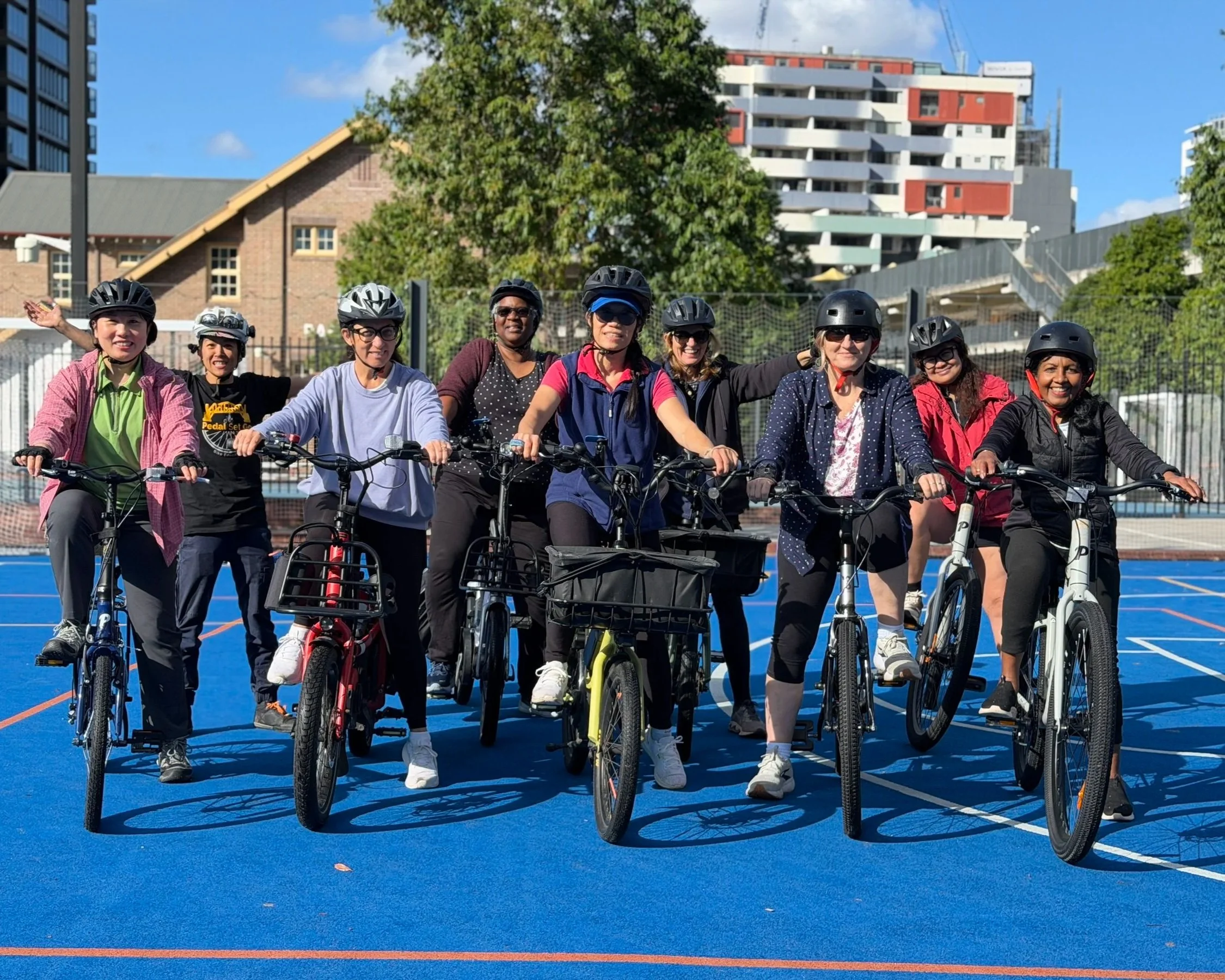
Confident City Rider , Women In Focus after 6 week program designed and delivered by Pedal Set Go on behalf of City of Parramatta Council and Transport for NSW