Is a Low Bike Saddle Bad for Your Knees? What the Evidence Actually Says
Written by Jules — Bike Educator, Pedal Set Go
“You need to raise your seat - having it that low is bad for your knees.”
It is advice bike riders hear all the time.
Sometimes it comes from a bike shop. Sometimes from an experienced rider. And sometimes it is unsolicited advice given to somebody who is right in the middle of learning to ride.
There is some truth behind the concern. Saddle height affects how your knees move, how your muscles work and the forces involved in pedalling. A saddle that is significantly lower than an efficient pedalling position can increase some types of knee and muscle loading, particularly when you are pushing hard.
But “a low saddle will damage your knees” is much more definitive than the research supports.
It also leaves out an important question:
What are you using the bike for - and what skills do you need right now?
A note about the cycling we teach
Pedal Set Go teaches cycling for transport and everyday life.
We do not teach racing or sport-performance cycling.
Our riders are learning to commute, ride to the shops, carry children or luggage, connect with public transport, use cycleways and streets, ride e-bikes and cargo bikes, explore their city and sometimes travel much longer distances or go touring.
That distinction matters.
Good bike fit is valuable for anybody spending significant time on a bike - not just competitive riders. A commuter riding substantial distances or somebody spending all day touring can benefit enormously from a comfortable, efficient position.
But transport cycling also involves something that a stationary bike-fit assessment does not:
stopping, starting, manoeuvring, balancing, responding to other people and dealing with unpredictable environments.
Sometimes those demands change what we prioritise.
We love good bike fit
This article is not an argument against good bike fit.
Far from it.
If I were heading off on a multi-day bicycle tour, I would pay very close attention to my bike fit. If I am repeating the same pedalling movement for hours, I want to be comfortable and efficient.
Research supports the value of bike fitting. A randomised trial involving 162 amateur riders found that a three-dimensional bike-fitting intervention produced greater improvements in reported pain, fatigue and comfort than simply giving riders general written advice about cycling posture.
Read the bike-fitting trial on PubMed
But if I am riding through the city, stopping frequently at intersections and crossings, or I am tired, I may deliberately lower my own saddle a little.
Those are not contradictory choices.
I am adjusting my bike for what I need it to do.
Why we sometimes deliberately lower a bike saddle
When somebody is learning to ride, our first priority is not maximising their power output or pedalling efficiency.
It is helping them build confidence at their pace and develop control.
That includes addressing their fears while learning to:
start smoothly
stop accurately and predictably
use the brakes effectively
balance at low speed
stay in control as the bike slows
put a foot down confidently when stationary
respond to an unexpected situation without panicking.
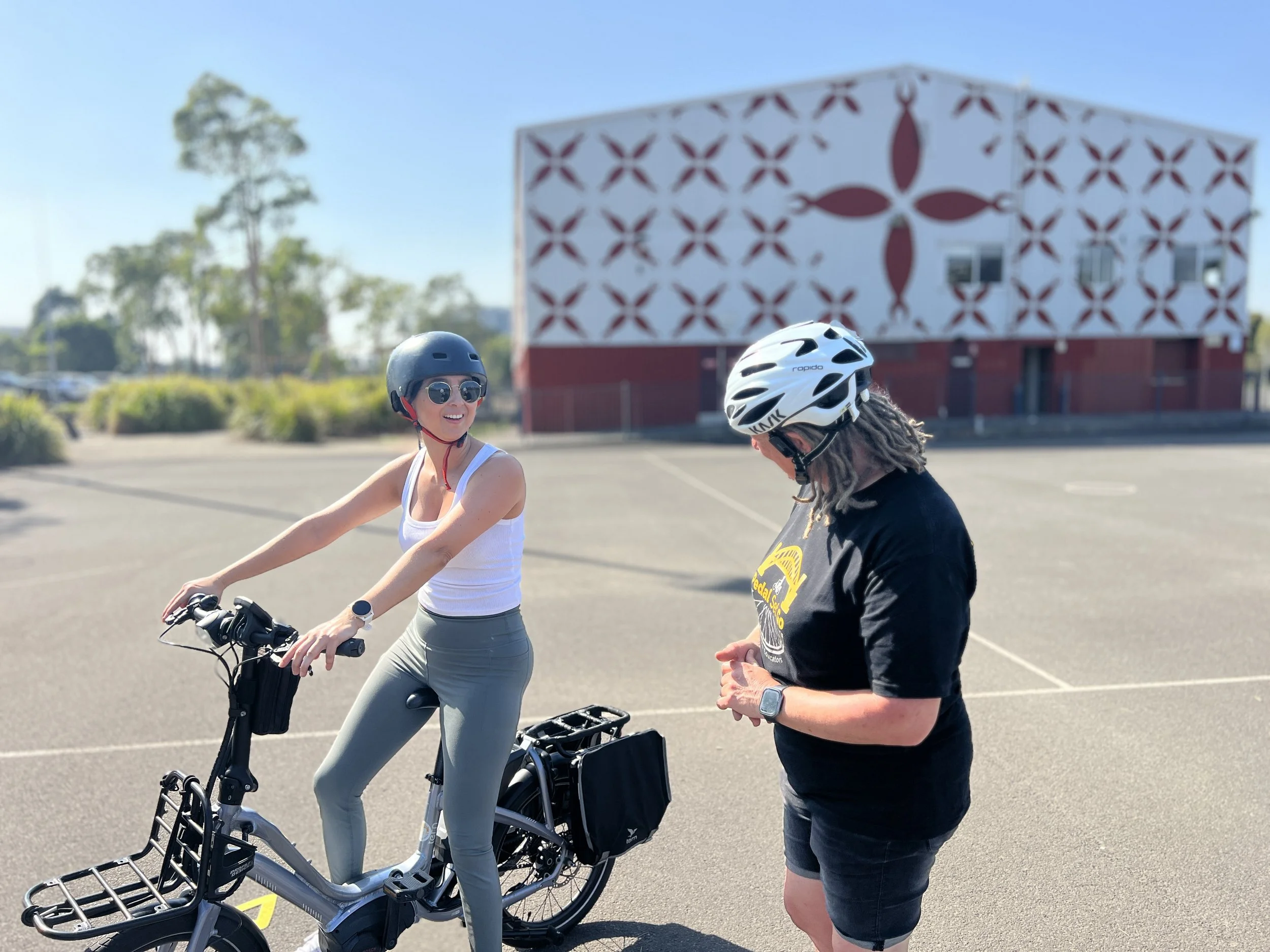
A lower saddle can give a learner easier access to the ground and a greater margin for error while those skills are developing.
As their control improves, we progressively raise the saddle towards a more efficient pedalling position.
You can read the practical setup process in our bike fit guide for children and adults learning to ride.
Research into adults learning to cycle also reinforces the importance of developing balance, speed control and confidence, rather than treating cycling as simply a matter of pedalling. A 2024 adult learning study found that balance-bike practice could successfully transfer into independent cycling.
Read the adult balance-bike study on PubMed
Confidence and skill are not the same thing
We also sometimes lower the saddle for riders who already consider themselves experienced.
Somebody may have ridden a bike for many years and be highly confident travelling at speed, yet have never deliberately practised:
a smooth controlled stop
sudden braking
precise low-speed control
stopping at a nominated point
controlled starts
safe mounting and dismounting.
Confidence is valuable.
But high confidence does not automatically mean high skill.
We regularly see riders compensate for gaps in bike-handling technique with momentum. They are comfortable while the bike is moving quickly, but stopping reveals the problem.
They may brake late, wobble as the bicycle slows, remove a foot too early, lean heavily to one side, jump off the saddle or make a last-second reach for the ground.
When we temporarily lower the saddle, we are not saying:
“This is your ideal permanent bike fit.”
We are saying:
“We are changing the bike setup while we work on this particular skill.”
Once the stop becomes controlled and repeatable, we can reassess the saddle.
What about the jolt when your foot suddenly hits the ground?
This is something we see in lessons and it deserves discussion.
If a rider has a relatively high saddle but does not yet have a good stopping technique, reaching the ground can become an abrupt movement.
Rather than stopping smoothly and placing a foot down under control, the rider may suddenly drop their body to one side and hit the ground harder than intended.
That can feel jarring through the foot, ankle, knee and hip.
There is good general biomechanical evidence that the way the body contacts the ground matters. Landing studies show that higher and stiffer landings produce greater ground-reaction forces and greater joint demands, with the knee playing an important role in absorbing that energy.
Read a study on lower-limb loading during different landing techniques on PubMed
However, this is important:
That research studied landing - not people stopping bicycles.
I have not found good research directly testing whether a high bicycle saddle combined with poor stopping technique increases knee injury risk when the rider puts their foot down.
So we should not pretend that relationship has been scientifically proven.
What I can say from teaching is that riders with poor stopping technique frequently describe an uncontrolled foot plant as uncomfortable or jarring. Lowering the saddle temporarily can make ground contact less of a reach while we teach the rider to stop more smoothly.
That is a skill and control consideration, not a claim that high saddles themselves injure knees.
Our wider bike safety information also emphasises keeping control of the bike throughout the stopping process rather than relying on a last-second foot to stop the bicycle.
So what does the research actually say about saddle height and knees?
A useful starting point is a 2022 systematic review.
Researchers examined 41 studies looking at methods of determining saddle height and what happened when saddle height was changed.
They found strong evidence that changing saddle height changes the way the lower limbs move while cycling.
That is not surprising.
But when saddle height changes were relatively small -less than about 4% of leg length - changes in measured lower-limb loads were generally trivial to small.
Most importantly, the researchers concluded that evidence directly connecting saddle-height changes with actual injury risk was limited.
Read the 2022 saddle-height systematic review on PubMed
That is very different from saying saddle height doesn't matter.
It means:
Changes in biomechanics are well established. Claims about actual injury are much less certain.
What about research on cycling pain and injury?
Another systematic review published in 2022 looked specifically at factors associated with overuse pain and injury in bike riders.
It found moderate evidence linking cycling load with symptoms.
The evidence connecting seat height with symptoms, however, was conflicting.
The authors also highlighted limitations in the quality of the available research.
Read the overuse-injury systematic review on PubMed
This matters because it challenges a very common assumption.
Looking at somebody's saddle and deciding that it must be causing - or will cause - knee pain is not supported by particularly strong injury evidence.
But lower saddles do change knee loading
We should not swing too far in the other direction.
A lower saddle is not biomechanically identical to a higher saddle.
A 2021 study had recreational riders cycle at several saddle heights and at workloads of 80 and 120 watts.
The lower saddle position produced a greater knee-extension moment.
In plain English, the muscles around the knee had to produce more turning force.
That suggests a lower saddle can increase some forms of knee loading.
But another result is just as important:
Increasing how hard the riders were pedalling also increased knee loading substantially.
Read the 2021 knee biomechanics study on PubMed
That distinction is central to this article.
The knee does not experience saddle height in isolation.
It experiences:
saddle height + gear + pedal force + cadence + hills + acceleration + duration + rider physiology + fatigue.
And on an e-bike, we can add:
motor assistance.
New 2026 research reinforces that point
A study published in June 2026 investigated three saddle heights combined with three different power outputs.
Twenty-five participants rode while researchers measured movement and pedal forces and used a musculoskeletal model to estimate muscle and joint forces.
Lower saddle positions were associated with greater flexion and increased loading in several lower-limb muscles and joints.
But higher power output also increased hip and knee extensor forces and joint forces.
The researchers concluded that a higher saddle within a comfortable physiological range combined with moderate power may reduce lower-limb loading.
Read the open-access 2026 study
Again, this supports good bike fit for sustained riding.
But it also reinforces something sometimes missing from public advice:
how hard you are pushing matters.
How hard you push the pedals matters - a lot
This isn't a new finding.
As far back as 1986, researchers examining workload, cadence(The number of pedal revolutions or turns, per minute), saddle height and foot position concluded that workload was the most important of those adjustments for changes in joint load and muscular activity.
Read the biomechanics study on PubMed
Think about two riders travelling up the same hill.
One is in a difficult gear, pedalling slowly and pushing extremely hard with every stroke.
The other changes to an easier gear and keeps the pedals turning comfortably.
Their knees are not doing the same job - even if their saddles are at exactly the same height.
Researchers have even measured forces inside the knee
One particularly interesting study involved nine people who had instrumented knee replacements capable of directly measuring forces inside the knee joint.
The participants cycled at different power levels, cadences and saddle heights.
It is a small study and people with knee replacements are not representative of the whole cycling population, so we should be cautious about generalising the exact numbers.
But the findings are useful.
Knee forces increased as cycling power increased.
The higher cadence tested produced smaller forces than the slower cadence.
And interestingly, lowering the saddle did not increase the overall resultant knee force in that particular experiment, although it did increase posterior shear force.
The lowest loads occurred with the combination of:
lower power + higher cadence + higher saddle.
Read the direct knee-force study on PubMed
This does not tell us that lower saddles are better for knees.
It tells us something more useful:
The amount of force a rider is producing is part of the equation.
If you choose a lower saddle, use your gears
This has a very practical application for everyday riders.
If you are using a slightly lower saddle because it gives you more confidence when stopping, don't compensate by grinding away in a very hard gear.
Use the gears.
Change down before the pedals become difficult to turn.
An easier gear generally lets you produce the required movement with less force on each pedal stroke.
This is particularly helpful:
when starting
before a hill
into a headwind
when carrying shopping
when carrying children or other loads
when you are fatigued
whenever the pedals start to feel heavy.
There is no single magic cadence that every rider needs to achieve.
For transport cycling, a much more useful instruction is:
If the pedals feel heavy, change to an easier gear.
Our practical tips for new riders explain gears, braking, saddle comfort and low-stress riding in more detail.
What about an e-bike? Use the motor
E-bikes make the saddle-height discussion even more interesting because the rider is no longer producing all of the propulsion.
The motor is sharing the work.
Researchers have instrumented an electric city bike to measure pedal forces, joint loading and muscle activity while changing the level of electric assistance.
As assistance increased, the amount of force produced by the rider decreased substantially.
At the highest assistance level tested, normal pedal force during part of the power phase fell by approximately 63%.
Activity in several major leg muscles also decreased.
Read the electric-assistance study
Another study involving 19 non-athletes similarly found changes in physiological demand, muscle activity and power output as electric assistance increased.
Read the pedelec assistance study on PubMed
A small 2026 pilot study involving ten people with knee osteoarthritis also found that higher e-bike assistance reduced activity in several major thigh muscles compared with cycling without assistance.
Read the 2026 knee osteoarthritis e-bike study
These studies do not prove that turning your e-bike to a higher assistance level will prevent knee injury.
But they do support a straightforward mechanical point:
when the motor does more of the work, the rider generally has to produce less of it.
So if your knees are uncomfortable, you are tired, you are climbing or you are starting repeatedly in city traffic:
use the assistance.
You bought an e-bike with a motor. You do not receive a prize for refusing to use it.
City riding and sustained riding place different demands on the rider
A rider travelling continuously for a long distance may pedal for a substantial period before needing to put a foot down.
City transport can be completely different.
Traffic lights.
Intersections.
Give-way points.
Pedestrian crossings.
Congestion.
Kerbs.
Driveways.
Other bike riders.
People walking.
Deliveries.
Roadworks.
Sometimes you barely get going before you need to stop again.
That changes what can make a bike comfortable and practical.
I sometimes lower my own saddle a little when I know I will be doing a lot of stopping and starting.
I may also lower it when I am fatigued.
That doesn't mean I've forgotten how to set up a bicycle.
At that moment, I value easier stopping and a little more margin for error more than maximising pedalling efficiency.
When the riding changes, the saddle can change again.
Saddle height doesn't have to be a sacred number
Mountain bike riders have been changing saddle height according to the task for years.
A dropper post allows the saddle to move down when manoeuvrability and body movement matter, then back up when efficient pedalling becomes the priority.
Urban riding is obviously not downhill mountain biking.
But the broader principle is useful:
A bicycle can be adjusted according to what the rider needs it to do.
For some riders, an adjustable seatpost or dropper-style setup can even be useful beyond sport cycling.
For others, a simple manual saddle adjustment is enough.
Much of the research is not about learning to ride in city traffic
This is another important limitation.
A large amount of saddle-height research measures steady-state cycling, often on stationary equipment, and frequently involves trained, recreational or otherwise established riders.
That research is useful for understanding biomechanics.
But it does not directly answer questions such as:
What saddle height best supports an adult who has never ridden before?
What setup helps somebody learn a controlled stop?
Should an experienced but poorly skilled rider temporarily lower their saddle during braking practice?
Does easier access to the ground reduce the severity of an uncontrolled stop?
How should saddle height change when fatigue affects a rider's balance and coordination?
What setup works best for repeated stop-start transport cycling?
There simply isn't enough direct research on those questions.
That is an evidence gap.
It is important to acknowledge it rather than pretending sport and laboratory bike-fit research answers every question in bike education.
We recommend that you listen to your body.
There is some research specifically looking at lower everyday saddle positions
One study deliberately examined a relatively lower seat height used in everyday public-road cycling, rather than beginning with a sport-performance riding position.
Researchers investigated how changes to bicycle geometry affected joint movement, muscle activity and physiological demand.
It was a small study involving eleven young men, so it should not be treated as a universal recommendation.
It also investigated physiology and biomechanics rather than injury.
But it is useful because it recognises something obvious to transport riders:
everyday cycling does not always look like performance cycling.
Read the everyday-cycling study on PubMed
So when should you raise the saddle?
We are certainly not suggesting riders should keep their saddles extremely low indefinitely.
As a rider becomes more competent, raising the saddle can:
improve pedalling efficiency
allow greater leg extension
reduce some muscle and joint loads
make sustained cycling more comfortable
improve the ability to produce power.
For longer-distance commuting, touring or sustained riding, bike fit becomes increasingly important because the same movement is repeated thousands of times.
This is where a well-adjusted saddle makes a great deal of sense.
At Pedal Set Go, our approach is usually:
control first → develop the skill → progressively optimise the fit.
Not:
find a theoretically perfect saddle height first and hope the rider learns to cope with it.
What if you already have knee pain?
Knee pain deserves more thought than simply moving the saddle up or down.
Consider:
how hard you are pushing the pedals
whether the gear is unnecessarily difficult
whether you have suddenly increased your riding distance
whether your route has become hillier
cadence
saddle height
saddle fore-aft position
crank length
footwear
cleat position if using clip-in pedals
fatigue
previous injuries
other health conditions.
A professional bike fit can be extremely useful, particularly for somebody riding substantial distances or experiencing persistent discomfort.
Persistent, worsening or significant knee pain should also be assessed by an appropriately qualified health professional rather than diagnosed from somebody's saddle position.
So, is a low bike saddle bad for your knees?
The evidence supports a more nuanced answer:
A substantially lower saddle changes knee mechanics and can increase some muscle and joint loads, particularly when you are pedalling hard. But the evidence does not support the blanket claim that riding with a lower saddle automatically causes knee injury.
Workload matters.
Gearing matters.
Cadence matters.
Distance matters.
Individual biomechanics matter.
Fatigue matters.
And if you are riding an e-bike, motor assistance matters.
For somebody learning to ride, rebuilding skills or practising better stopping technique, temporarily lowering the saddle can be a useful teaching choice.
As control develops, we can raise it progressively.
For longer-distance and sustained higher-effort riding, an appropriately adjusted saddle becomes increasingly important for comfort and efficiency.
Same rider. Different ride. Different priorities.
Before telling somebody their saddle is too low…
If you see somebody riding with a saddle that looks unusually low, there may be a reason.
They might be:
learning to ride
rebuilding confidence after a long break
practising stopping
managing fatigue
carrying a load
riding an unfamiliar bicycle
adapting to an e-bike
dealing with mobility or balance issues
riding a route with constant stopping and starting
following instructions from their bike educator.
Well-intentioned advice such as:
“Raise your seat or you'll ruin your knees”
can undermine somebody's confidence just as they are beginning to trust themselves on a bike.
It can be particularly unhelpful when an instructor has deliberately changed the bike setup to teach a specific skill.
There will be plenty of time to refine saddle height.
First, we want the rider to have the skills to control the bicycle.
Then we can work towards the bike fit that best suits where, how and how far they want to ride.
Want help with your bike skills?
Already know how to pedal but want to improve your braking, stopping, gears, bike handling or confidence in real city conditions?
Pedal Set Go teaches practical cycling for transport, including new riders, returning riders, e-bike riders and people who have ridden for years but want to improve their real-world skills.
Explore our bike lessons and cycling courses in Sydney, or visit the Pedal Set Go Knowledge Hub for more practical riding advice.
Evidence and further reading
Saddle height and injury risk
Bini R, Priego-Quesada J. (2022). Methods to determine saddle height in cycling and implications of changes in saddle height in performance and injury risk: A systematic review.
Review of 41 studies. Particularly useful because it found strong evidence that saddle height affects movement, but limited evidence about actual injury risk.
https://pubmed.ncbi.nlm.nih.gov/34706617/
Cycling overuse pain and injury
Visentini PJ, McDowell AH, Pizzari T. (2022). Factors associated with overuse injury in cyclists: A systematic review.
Found moderate evidence linking cycling load with symptoms, while evidence connecting seat height with symptoms was conflicting.
https://pubmed.ncbi.nlm.nih.gov/35151569/
Saddle height and knee loading
Hummer E, Thorsen T, Zhang S. (2021). Does saddle height influence knee frontal-plane biomechanics during stationary cycling?
Lower saddle positions increased knee-extension moment. Increasing workload also substantially increased knee moments.
https://pubmed.ncbi.nlm.nih.gov/33640622/
New research on saddle height and power
Bing F, Chen TLW, Zhang G, Wang Y, Zhang M. (2026). The effects of saddle height and power output on lower-limb muscles and joints during cycling.
Recent modelling research showing that lower saddle heights and greater power output can both increase lower-limb loading.
https://link.springer.com/article/10.1186/s13102-026-01779-6
Direct measurements of forces inside the knee
Kutzner I, et al. (2012). Loading of the knee joint during ergometer cycling: telemetric in vivo data.
A small study using instrumented knee replacements. Forces increased with cycling power; higher cadence produced lower forces. Lower saddle height increased posterior shear but did not increase overall resultant knee force in the tested conditions.
https://pubmed.ncbi.nlm.nih.gov/23346556/
Workload, cadence and joint loading
Ericson MO. (1986). On the biomechanics of cycling: a study of joint and muscle load during exercise on the bicycle ergometer.
An older but useful biomechanics study which found workload was the most important of the tested adjustment factors affecting joint loading and muscle activity.
https://pubmed.ncbi.nlm.nih.gov/3468609/
Lower saddle positions in everyday cycling
Watanabe K. (2020). Effect of seat tube angle and crank arm length on metabolic and neuromuscular responses and lower extremity joint kinematics during pedalling with a relatively lower seat height.
Useful because it specifically considered a relatively low saddle position associated with everyday public-road cycling rather than assuming a performance position.
https://pubmed.ncbi.nlm.nih.gov/32008066/
E-bike assistance and rider-generated load
Influence of Electrically Powered Pedal Assistance on User-Induced Cycling Loads and Muscle Activity during Cycling. (2021).
Increasing electric assistance substantially reduced rider-generated pedal forces and lower-limb muscle activity.
https://www.mdpi.com/2076-3417/11/5/2032
E-bike assistance in non-athletes
Integrated Physiological, Biomechanical, and Subjective Responses for the Selection of Assistive Level in Pedelec Cycling. (2021).
Examined muscle activity, power output, physiological effort and perceived exertion at different levels of electric assistance.
https://pubmed.ncbi.nlm.nih.gov/34955875/
E-bikes and knee osteoarthritis
A Pilot Study on Whether Cycling with Different Levels of Electronic Assistance Changes Muscle Activity of the Lower Limb in People with Knee Osteoarthritis. (2026).
A small pilot study involving ten participants. High assistance reduced activity in several major lower-limb muscles compared with cycling without assistance.
https://www.mdpi.com/2076-3417/16/4/1713
Adult cycling skill acquisition
Positive skill transfer in balance and speed control from balance bike to pedal bike in adults: A multiphase intervention study. (2024).
Supports the importance of balance, speed control and confidence when adults are learning to ride.
https://pubmed.ncbi.nlm.nih.gov/38422110/
Bike fitting, pain, fatigue and comfort
Effectiveness of a 3D bikefitting method in riding pain, fatigue, and comfort: a randomized controlled clinical trial.
A randomised trial involving 162 amateur riders supporting the value of individualised bike fitting for comfort, fatigue and reported pain.
https://pubmed.ncbi.nlm.nih.gov/36408812/
Ground-contact forces — important limitation
Zhang SN, Bates BT, Dufek JS. (2000). Contributions of lower extremity joints to energy dissipation during landings.
This is not a cycling study. It is included only to explain the general biomechanics of abrupt foot contact: greater landing height and stiffer landing strategies increased peak ground-reaction forces and joint demands.
It should not be cited as proof that high bicycle saddles cause knee injuries during stopping.
https://pubmed.ncbi.nlm.nih.gov/10776901/
This article provides general bike-education information and is not medical advice. Persistent or significant knee pain should be assessed by an appropriately qualified health professional.
Seat height set low for new rider, so the can confidently touch the ground as they build confidence after their first transition to pedals.